
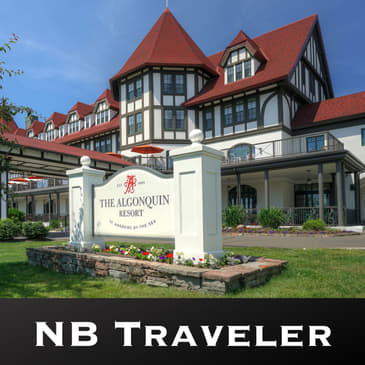

St. Andrews by the Sea was one of the places that the Loyalists arrived at in 1783. Lesser known and talked about than Saint John, it was still an important port on the Bay of Fundy. And then later in the 1830s it was one of four arrival ports for the Irish emigrants. This podcast takes a brief look at the Loyalists that arrived there and the Irish that followed. The NB Traveler shares this not as a seasoned historian, but rather as one that is curious about the dynamics that formed the New Brunswick culture. If you have comments or would like to come on the NB Traveler podcast and share more insights about NB Loyalists and the Irish, just contact me. Below are links to sources that I have read for this podcast.
Some other place … than here by Ronald Rees
Old New Brunswick by David Sullivan
In the Wake of Loyalists: Retracing their path across the Bay of Fundy by Robert A. Liftig, EdD
Irish Canadian Cultural Association of New Brunswick
The Exodus of the Loyalists from Penobscot to Passamaquoddy by Wilbur H Seibert
[00:00:00] I am Mark the New Brunswick Traveler and here we talk about New Brunswick stuff.
[00:00:13] New Brunswick's often referred to as a drive through province, going to Prince Edward
[00:00:18] Island or Nova Scotia but more and more were becoming a destination province where people
[00:00:24] are coming to spend the night, spend a week or spend the rest of their life.
[00:00:32] There's so many great wonderful treasures and natural resources here that we can experience
[00:00:38] from the Bay of Funday to Mount Carlton to all of the various things that are in between.
[00:00:45] On this podcast I'll be talking about some of those natural wonders.
[00:00:50] We're talking about some of the people that live in New Brunswick past visitors that
[00:00:54] have come to New Brunswick and maybe even some ghosts that I find along the way.
[00:01:00] So for now let's get started.
[00:01:04] A few weeks ago I purchased a book from the New Brunswick Historical Society entitled
[00:01:16] Some Other Place Than Here, St Andrews and the Irish Immigrant, written by Ronald Rees.
[00:01:24] Part of this podcast will be sharing some of what I learned from reading that book.
[00:01:30] St Andrews is one of four ports where the Irish landed during the 1800s when thousands
[00:01:36] of them came into New Brunswick.
[00:01:39] The two main ports were Quebec City and St John.
[00:01:43] Here a machine was a fourth and after the early 1830s each of these ports had a quarantine
[00:01:50] station on an island where the ships would stop first.
[00:01:54] In the case of St Andrews it was Little Harwood Island which became known as Hospital
[00:02:02] Island, a barren two acre piece of land almost inaccessible at certain times and pass them
[00:02:10] a quality bay.
[00:02:12] St Andrews is one of my favorite places to visit here in New Brunswick.
[00:02:16] For me it's a Quaint Tourist Town with a great harbor for recreational boating and for
[00:02:22] fishing trips and whale watching.
[00:02:26] I had just not thought of it as one of those important seaports of the 1800s in New Brunswick.
[00:02:34] Like St John, St Andrews was the community on the Bay of Fundy that the loyalists came
[00:02:39] to in 1783.
[00:02:42] But the loyalists that came to St Andrews were in somewhat different circumstances and
[00:02:47] the ones that came in various fleets to St John.
[00:02:52] Those coming to St John had come from New York and in most cases brought very little
[00:02:56] with them.
[00:02:58] On the other hand, the St Andrews loyalists had come from Castine, Maine.
[00:03:03] In many cases they brought their houses with them fully disassembled and then rebuilt
[00:03:10] in this new place called St Andrews.
[00:03:15] Castine is one of the oldest communities in North America having been occupied since
[00:03:20] the early 1600s.
[00:03:22] Historians call it the battle line of four nations.
[00:03:27] It has lived under four flags and has witnessed numerous hand-offs between the empires.
[00:03:33] The French twice, the Dutch, the English four times and the Americans incredibly twice.
[00:03:42] Its ancient Bayside houses narrow colonial lanes and the remnants of its forts that were
[00:03:49] built under different names have seen a lot of action over the ages, including one
[00:03:55] fort that the Dutch blew up a year after they had built it.
[00:04:00] And its fortunes have flourished, faded and risen again with surprising regularity.
[00:04:09] Toward the end of the American Revolution, the 74th regiment of foot also known as
[00:04:15] the Argyle Highlanders surprised the port and seized it from the American colonists.
[00:04:23] This was up until then the most ambitious amphibious invasion in British colonial history.
[00:04:32] Despite the eventual success of the rebellion to the south, the British never surrendered
[00:04:38] Castine in a military action.
[00:04:42] They held onto it both for strategic purposes and to keep a place of refuge for loyalists
[00:04:49] from the colonies.
[00:04:52] In fact, they referred to it as New Ireland.
[00:04:57] The United Colonies military efforts to recover Castine after it was lost to the British resulted
[00:05:04] in the greatest naval disaster of US history until Pearl Harbor in 1941.
[00:05:13] In 1779 the largest Armada ever to be assembled by the American rebels was decisively defeated
[00:05:21] by the cunning, craft and defensive capacity of his Majesty's forces.
[00:05:29] Who were vastly outnumbered by the way?
[00:05:32] Holding Castine was 700 British troops from the Royal Artillery, the 74th Highlanders
[00:05:40] and the 82nd Duke of Hamilton's Regiment.
[00:05:44] Three colony-on-avel warships left Boston with more than 40 other ships, including
[00:05:51] private vessels.
[00:05:53] More than a thousand New England militia were hell-bent on destroying the British.
[00:06:00] The expedition was supposed to have been a slam dunk for the rebel cause, but it turned
[00:06:05] into a strategic and financial catastrophe.
[00:06:10] Few died on either side, but it eventually cost the newly-mined US government a staggering
[00:06:17] $300 million.
[00:06:20] The main relocated once some of the loyalists who had removed to Castine must have been
[00:06:25] reluctant to immigrate again.
[00:06:27] However, the king offered them land grants across the Bay of Fundy.
[00:06:33] On 3 October 1783 two large transports and several smaller vessels with forty families
[00:06:41] arrived at St. Andrews and over the next four months the rest of the loyalists from Castine
[00:06:48] followed them.
[00:06:50] By June of 1784 St. Andrews had grown to a population of 178 men, 102 women and 369 children
[00:07:02] for a total population of 649.
[00:07:06] In 1784 Charles Morris Jr. deputies surveyor laid out the town of St. Andrews in its regular
[00:07:14] and uniform plan, with six parallel streets running lengthwise and thirteen streets cutting
[00:07:20] them at right angles.
[00:07:23] By June of 1784 90 houses had been built, many of them a material that the loyalists
[00:07:29] had brought with them from Castine.
[00:07:32] The same street plan continues to be used today, and I've walked many of those streets.
[00:07:39] For a while after the loyalists arrived there was a dispute with the state of Maine over
[00:07:45] which River historically had been the St. Croix.
[00:07:49] That was the boundary line that had been established by Treaty.
[00:07:54] Had the determination been made that the St. Croix was actually a river east of St. Andrews
[00:08:00] the colonists would have found their new village to still be in the United States.
[00:08:07] Fortunately it was established that the St. Croix was the river running through St. Stephen.
[00:08:14] So now back to talking about the Irish who came to New Brunswick and more specifically
[00:08:20] to the ones who came to St. Andrews.
[00:08:23] There were Irish settlers in what is now to Brunswick almost a hundred years before
[00:08:29] the arrival of the loyalists and the establishment of the province.
[00:08:33] Many of the loyalists themselves had Irish surnames.
[00:08:37] Before 1800 the Irish presence was garrously noticed by the bulk of the population.
[00:08:44] The beginning of the timber trade brought the Irish to New Brunswick in no worthy numbers.
[00:08:50] More Irish immigrants began trickling into New Brunswick during the American Revolution
[00:08:56] days, mostly Protestant Irish at first but after 1815 Irish Catholics as well.
[00:09:03] As early survivors were for the most part single man with skill or trades and they generally
[00:09:09] could also afford passage.
[00:09:13] Many were literate and once settled they sent letters home.
[00:09:18] These letters brought news of the colony back to Irish villages.
[00:09:24] They were read by family and friends and passed around because any news from America
[00:09:30] was deemed important and shared by all.
[00:09:34] News of the colony in life there was essentially passed on by word of mouth as well.
[00:09:40] These letters brought a sense of hope, a reason to believe that things could be better if
[00:09:46] they could only get to North America.
[00:09:49] Some letters also contain money.
[00:09:52] Funds sent back to families so that another family member could afford to make the journey
[00:09:58] across the Atlantic and join them.
[00:10:01] Although there were some Irish born loilists for example Peter Clinch who founded St.
[00:10:07] George, immigration from Ireland in New Brunswick began in earnest after 1815, following
[00:10:14] the Napoleonic Wars in Europe and the blockade of the Boldic States, the source of much
[00:10:21] of England's timber supply.
[00:10:24] This led England to look to North America to replace those supplies and created the
[00:10:30] need for labors in the forests and the mills.
[00:10:34] Ships carrying lumber overseas, although ill-equipped for carrying passengers, provided cheap
[00:10:41] passage and a returning payload for their owners in the form of human cargo.
[00:10:48] On the timber ships the Irish could come here, perhaps the price of passage to Boston.
[00:10:54] Or New York City.
[00:10:56] And St. Andrews was promoted by those in Europe as the closest port to the United States.
[00:11:04] Hence the title of the book I was talking about, some other place than here.
[00:11:10] Many Irish coming to St. Andrews thought that it was simply a short trip to Boston, what
[00:11:16] is surprise they were in for.
[00:11:19] And to complicate the lives of those loyal citizens of St. Andrews who were receiving
[00:11:25] these new Irish immigrants, cholera had entered the province.
[00:11:30] Asiatic cholera invaded Europe and had arrived in the slums off Glasgow, Velfast and Dublin
[00:11:39] by March 1832.
[00:11:41] And by the summer of 1832 it slipped into Quebec City in Montreal.
[00:11:47] This was the beginning of the need for the quarantine stations and the battle to keep
[00:11:52] both cholera and other sicknesses that followed, at bay.
[00:11:57] Only a week or two after the cholera outbreak in Quebec a St. Andrews newspaper reported
[00:12:03] that a captain had been found guilty at the St. Andrews courthouse of attempting to conceal
[00:12:09] a man and two children infected with smallpox.
[00:12:13] By May 1832 all vessels had to be quarantined for at least 24 hours that had come from places
[00:12:21] where there was the smallest suspicion of cholera.
[00:12:25] At the least sign of infection or even at the suspicion that the vessel was directed
[00:12:30] to hospital island.
[00:12:33] There the passengers might be detained, they and their baggage cleaned, and the vessel
[00:12:39] ventilated and fumigated.
[00:12:42] In the early 1840s the death rate on vessel sailing from Liverpool and the Irish sports
[00:12:47] to St. Andrews was less than 1%.
[00:12:52] All that changed during the famine years of 1846-49.
[00:12:57] Now it was the ragged, despondent, and often sickly passengers crammed together on the ships
[00:13:04] that had been designed to carry timber, not people.
[00:13:09] With five vessels on their way to St. Andrews in May 1847 the town began to prepare.
[00:13:17] One of these ships was the Elizabeth Grimmer, a St. Stephen vessel built for the timber
[00:13:22] trade.
[00:13:23] Of the 229 passengers aided died of typhus fever on the journey.
[00:13:30] It was quarantined at hospital island for seven days.
[00:13:34] On the sixth day the symptoms of fever showed up and over a hundred of the passengers were
[00:13:39] then detained.
[00:13:41] Some at hospital island and others in the house on the outskirts of St. Andrews.
[00:13:48] The stories of the other ships was similar.
[00:13:51] For those immigrants would mean to move on, and for the Catholics in particular the promised
[00:13:57] land was seldom British North America.
[00:14:00] The fares were cheaper so they selected St. John or St. Andrews as the port of arrival,
[00:14:06] but they were really on their way to the United States.
[00:14:09] East Port Maine was a short ferry ride from St. Andrews.
[00:14:14] Or for those who did not have the money.
[00:14:18] It was a walk to Bangor about 120 miles distance.
[00:14:23] In 1834 one newspaper reported, our roads had been swarming with Irish men, women, and
[00:14:30] children some days from 50 to 100 pass along.
[00:14:35] After the same fashion as that adopted by the Eastern pogroms with script and staff begging
[00:14:43] at every house on the road, in many cases they stopped in callus finding work there.
[00:14:51] Some of the Irish that came to St. Andrews came specifically to work on the St. Andrews
[00:14:56] in Quebec railway.
[00:14:59] This was true at the ship-star that arrived in Port on May 8, 1848.
[00:15:05] In late April it had left New Ross Ireland with 133 men, 122 women and 128 children.
[00:15:15] Upon arrival 63 of the passengers were sick.
[00:15:18] All were placed on hospital island and due to overcrowding the number of sick increased
[00:15:24] to 89 and 11 others had died.
[00:15:29] Some of the aged widowed and orphaned passengers were sent to the Forthouse farm on the Forseida
[00:15:35] town, and the railroad company provided little and suitable accommodations for the workers
[00:15:42] that were working hard who had been left behind.
[00:15:46] Both the story of the failed railroad and the Forthouse, or Almshouse as it was also called,
[00:15:54] are something I might talk about in the future.
[00:15:57] St. Andrews was unmistakably a loiless creation, but by the middle of the century it had
[00:16:05] a distinctively Irish cast.
[00:16:08] 52% of the heads of the household were Irish born, but despite superiority of numbers,
[00:16:16] it would take the Irish generations even to loosen the Anglo-Scots control of town and
[00:16:24] country affair.
[00:16:28] It's been a real joy being with you today.
[00:16:33] I appreciate you taking the time to listen to the podcast.
[00:16:38] If you go to my website mbtraveler.com, you can leave a comment, you come to do a rating
[00:16:44] and I look forward to seeing you back here again next week.
[00:16:48] And oh by the way, you can also buy me a coffee there on that website if you care to.
[00:16:55] Have a great day and a wonderful week.