
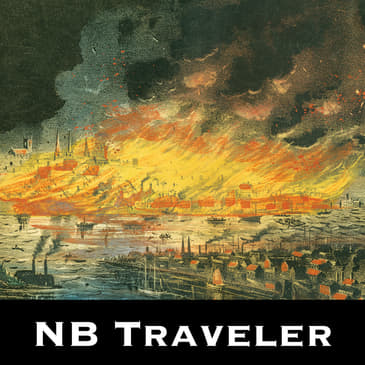

In this episode, Mark Greene shared the inspiration behind his book The Great Saint John Fire of 1877, which began with his childhood fascination with the event. He explained that Saint John was a significant port city, founded by Loyalists in 1783, and had grown to become the third-largest city in Canada by the mid-1800s. Despite being prone to fires due to its rapid construction and lack of fire prevention, the city was rebuilt each time after the 13 previous major fires, continuing to ignore practices that were needed for fire prevention.
The fire of 1877 was a catastrophic event that destroyed much of the city's wooden infrastructure and left 14,000 homeless. The fire, which started in a warehouse district, was exacerbated by a deflation explosion and spread quickly due to strong winds. The city's lack of building codes and fire prevention measures at the time were cited as contributing factors. In the aftermath of the fire, the city rebuilt under new building codes, prioritizing fire prevention and resulting in a more resilient and rebuilt city. Despite its significance, the Great Saint John Fire is not as widely known as other urban fires of the era.
You can purchase the book The Great Saint John Fire of 1877 by Mark Allan Greene from your local bookseller, or wherever books are sold.
[00:00:04] Hello, I'm Mark the Envy Traveler, and here we talk about New Brunswick stuff.
[00:00:10] Today I'm going to be interviewing an author of The Great Fire in St. John in 1877.
[00:00:20] I find it to be a very interesting interview.
[00:00:24] A special thanks to Denis Lepage for buying me a cup of coffee.
[00:00:28] If you'd like to also buy me a cup of coffee, you can go to my website at mbtraveler.com and purchase one there.
[00:00:38] I hope that you enjoy this information about the Great St. John Fire of 1877.
[00:00:47] Here it comes.
[00:00:52] I'm here today with Mark Green, the author of The Great St. John Fire of 1877.
[00:01:00] Welcome, Mark.
[00:01:01] Thanks, Mark, for having me. Great first name, by the way.
[00:01:05] Yes, it is, and it's Mark with a K.
[00:01:08] Mark with a K.
[00:01:09] So welcome to The Envy Traveler.
[00:01:12] What inspired you to write a book about the Great St. John Fire of 1877?
[00:01:17] Well, I have to go back quite a ways to give you an answer for that, and back to my elementary school days growing up in St. John.
[00:01:24] And I had a, it was grade two, so that's going back a long ways.
[00:01:28] And a friend of mine did a project on the bell that fell from St. David's Church.
[00:01:36] And that did not happen in the fire, but the bell went up during the fire.
[00:01:40] And I remember my school teacher saying, yeah, you know what?
[00:01:45] There was this great fire that was in the uptown area of St. John.
[00:01:51] I was like, oh, no, great fire.
[00:01:52] So, like, did it take out Market Square?
[00:01:55] And she said, no.
[00:01:57] Took out the entire uptown area.
[00:02:00] So, oh, you mean around Forensic Square and that, like up King Street?
[00:02:03] No.
[00:02:04] The entire uptown area, the entire peninsula.
[00:02:08] And it just blew my mind.
[00:02:09] And it stuck with me throughout the years is this big fire.
[00:02:14] And then, fast forward about 30 years when I was looking for getting into writing and I was looking for a novel or idea for a novel, for a historical fiction novel.
[00:02:26] And then that came to my mind, the great St. John fire, because nothing had really been done on it.
[00:02:32] So, I ended up, that memory came back.
[00:02:36] But then I realized, Mark, is I knew about the event, but knew nothing of the story of great St. John fire.
[00:02:44] So, that's when I started researching and understanding what actually happened.
[00:02:48] So, can you give us an overview of what St. John's status as a major port city was prior to the fire?
[00:02:54] That's quite a back story.
[00:02:57] And if you've read the book, I spend the first two chapters of going into what St. John was at the time so that the reader can understand what it was and what was lost on June 20th, 1877.
[00:03:09] So, it was nothing to begin with, 1783.
[00:03:13] The peninsula itself was a big rock that the Loyalists landed on and they were promised a city.
[00:03:20] They got there and there was nothing except barren rock.
[00:03:24] And they had to build something quickly.
[00:03:27] So, they spent the first year and some second year, including the winter, in tents.
[00:03:34] And you can imagine the St. John winter, Mark, spent in a tent.
[00:03:40] Well, I can't imagine actually living in a tent during a St. John winter.
[00:03:44] But they did.
[00:03:45] So, they built up a city quickly.
[00:03:48] And they built it of wood.
[00:03:50] And they built everything close together.
[00:03:53] And it didn't have fire prevention in mind at all.
[00:03:59] But eventually, they built a remarkable city that was, at one time, the third largest city in what would become Canada.
[00:04:08] Well, I know that this wasn't the first fire that occurred in St. John.
[00:04:13] So, what made this different than the other fires that had come prior?
[00:04:17] Yeah.
[00:04:19] So, there were 13 fires that happened.
[00:04:22] 13 major fires that happened before the great St. John fire.
[00:04:26] And what happened every single time.
[00:04:29] So, again, kind of go back to your question about what St. John was.
[00:04:33] It was a major, major city worldwide at one point.
[00:04:38] If you would ask people around the world in the 1850s, name three cities in Canada.
[00:04:47] Or, sorry, three cities in North America.
[00:04:49] They would say, oh, well, okay, I'll give it to you.
[00:04:52] Boston, New York, St. John.
[00:04:54] So, that's how big it was and how internationally known it was.
[00:04:58] But they had to build up a city quickly.
[00:05:02] And it burned down all the time because they were building it quickly without fire prevention in mind.
[00:05:07] But every time they rebuilt after these 13 major fires, they built things higher, closer together, and with less thought on fire prevention.
[00:05:19] From the historic record, some said that these weren't even structurally sound buildings, let alone fireproof.
[00:05:26] So, this was going to happen.
[00:05:28] And then along comes June 20th, 1877.
[00:05:33] Give you a little bit of background on June.
[00:05:36] And this will blow your mind, Mark, being in St. John.
[00:05:40] So, St. John, June.
[00:05:43] It was unseasonably hot.
[00:05:46] We were talking about the mid and high 20s every day.
[00:05:50] And no rain for three weeks before this.
[00:05:54] Not even fog.
[00:05:55] So, you had all of these wooden structures, everything close together, no fire prevention in mind.
[00:06:03] And then you had the right conditions happening for this big thing.
[00:06:07] And it was really hot on June 20th.
[00:06:10] And then a wind blew in from the northwest.
[00:06:15] And everyone goes, oh, that feels good.
[00:06:18] It feels good to get some relief from this heat.
[00:06:20] Blows in, but they have no idea what's going to start in the northwest sector of the peninsula.
[00:06:28] Just by the boardwalk of Market Square.
[00:06:31] That's where the fire started.
[00:06:32] So, those things coming together started a big inferno.
[00:06:40] And we can get into a bit more about the details about how this thing took off really quickly.
[00:06:46] Well, I think part of the issue, too, there were so many ships that were in the wharf area there
[00:06:52] that the fire, as it began, sort of went ship to ship as the wind was blowing to the lung, didn't it?
[00:07:00] Well, a couple of things happened.
[00:07:02] So, one thing that happened was there's two types of explosions.
[00:07:09] There's detonation and then there's deflagration.
[00:07:13] And a deflagration explosion is a dust explosion.
[00:07:19] So, what we had was the fire happened in the warehouse district.
[00:07:23] And there were a bunch of coal warehouses and flower warehouses.
[00:07:28] And what happens when those things start to catch on fire?
[00:07:34] You can get this deflagration happening.
[00:07:37] And what happens with that?
[00:07:39] It's not as powerful of an explosion.
[00:07:42] It's not like a detonation that you're going to get this big shock wave.
[00:07:45] But it is in a very confined space.
[00:07:49] You get a flower going up into the air.
[00:07:51] And then it all catches on fire all at once and causes an explosion.
[00:07:57] That's the first explosion.
[00:07:59] Then the first explosion puts more dust in the air.
[00:08:04] Then you get a secondary explosion and often a tertiary explosion.
[00:08:07] And what happens in a confined space?
[00:08:10] It makes the building explode up and out.
[00:08:14] So, all this flaming debris went hundreds and hundreds of feet into the air, swept by the gale force winds.
[00:08:23] So, you didn't have a wave of fire like you usually have that you could go, oh, there's a fire coming at me.
[00:08:29] I got to get out of the way.
[00:08:30] It went up in the air and the peninsula started burning in 12 places at the same time.
[00:08:37] So, people were surrounded by fire.
[00:08:40] And then the wave came from the original fire.
[00:08:43] So, they had to rebuild.
[00:08:47] And what did the residents do and how did they respond after the fire was over?
[00:08:53] Interesting enough, there was a lot of miracles, a lot of curses with this fire.
[00:08:58] So, there was the original response.
[00:09:00] And I should say, too, there wasn't just one St. John fire, Great St. John fire on that day.
[00:09:06] There were two.
[00:09:09] Because around Linster Street, someone set a fire.
[00:09:12] So, there was an arson.
[00:09:13] So, there was a second front created.
[00:09:16] And that took out the eastern part of the peninsula.
[00:09:19] So, if it were just the original fire, the eastern part probably would have been saved.
[00:09:24] But there was the work of arson.
[00:09:26] So, there was a second fire that took out the other side of it.
[00:09:30] But there were miracles and curses that happened that day.
[00:09:33] And one of the curses that happened the day after.
[00:09:36] Remember, Mark, I said it didn't rain for three weeks?
[00:09:40] Yes.
[00:09:40] Guess what happened the day after?
[00:09:42] Then you started getting rain.
[00:09:44] It rained and poured down on, what was it, 14,000 homeless people.
[00:09:50] So, it was just like the initial response of St. John's were, what did we do to make God angry?
[00:10:00] So, it was like, this city is cursed.
[00:10:03] This city has done whatever it's done.
[00:10:06] It's been cursed by God.
[00:10:07] So, there were some sermons that I was able to find from the Sunday after.
[00:10:12] And you could tell that the preachers were really focused on, no, this is not God's hand.
[00:10:20] God did not destroy St. John.
[00:10:22] Man destroyed St. John.
[00:10:24] And why?
[00:10:25] Because it had no building codes, Mark.
[00:10:27] New Brunswick had no building codes.
[00:10:29] You could do whatever you wanted.
[00:10:31] You could build anything you wanted.
[00:10:33] You want a fireplace in your living room without a chimney?
[00:10:36] You can have a fireplace in your living room without a chimney.
[00:10:39] You can do anything you want.
[00:10:41] So, the big thing that happened after the fire was this push going, no, never again.
[00:10:47] We need to have building codes.
[00:10:50] So, the New Brunswick legislature did an emergency session in September of that year to pass the first building codes.
[00:10:56] So, yes, they rebuilt, but they rebuilt under a different system where they had to meet certain building code standards and fire prevention was at the forefront.
[00:11:08] So, how long did it take St. John to recover after the fire?
[00:11:12] It depends on what you call recovery.
[00:11:14] So, the first thing I find absolutely remarkable, you know, given that they were dealing with wagons, horse-drawn wagons, they cleared the debris of the Great St. John Fire within four weeks.
[00:11:29] All the stone, all the burnt wood, all of the everything that was destroyed, they cleared it within four weeks and then the rebuild started right away.
[00:11:39] So, some of the first things to be rebuilt would have been the federal government buildings.
[00:11:43] So, the federal government came in and provided money for the original rebuild.
[00:11:48] And then some of the bigger commercial outfits.
[00:11:51] The residential was a little bit lagging, but within five years, the city was rebuilt completely, more beautiful than ever.
[00:12:02] And with that fire prevention in the forefront of people's minds, and you can see it today, you can see the brick.
[00:12:08] You're not going to see wooden buildings in that uptown area.
[00:12:15] You're going to see everything brick.
[00:12:16] And the other thing you're going to see, Mark, you're going to see flat roofs because that was a big deal.
[00:12:22] They had the high-pitched roofs before, which was great.
[00:12:27] They were great.
[00:12:28] They were fantastic for the snow, fantastic for the rain, and they were fire catchers.
[00:12:34] So, they rebuilt them.
[00:12:36] They go, no, you got to keep it flat, and you can't have wooden roofs because that's how the fire even got destroyed stone buildings.
[00:12:43] You have to have it.
[00:12:46] If you're having a wooden roof, it's got to be flat, and then you got to put a terracotta, stone, gravel, something to protect those roofs.
[00:12:54] So, it was better than ever when it was rebuilt.
[00:12:58] You have a lot of fantastic photographs in your book.
[00:13:03] How did you go about selecting the archival images that you've included?
[00:13:08] Yeah, so it was an interesting evolution of this book on how it happened.
[00:13:13] As I was saying, I originally went out to write a novel on the Great St. John Fire, and I did.
[00:13:20] And I pitched it to a few publishers, and it received some good responses, but a lot of passes until I came to one publisher who said, yeah, we don't do historical novels.
[00:13:33] And they actually called me up, and I was like, oh, well, thanks for calling me up.
[00:13:37] Most people just write me a letter saying I'm not interested in this.
[00:13:41] But they called me up.
[00:13:42] They go, yeah, we don't do this, but we're so interested in the story.
[00:13:46] Will you write a nonfiction book about the Great St. John Fire?
[00:13:50] And I said, absolutely, I'll write that.
[00:13:53] But they didn't know quite what they wanted.
[00:13:55] So, we played around with a couple of different formats, creative nonfiction, that kind of stuff.
[00:14:00] Then we landed on, you know what, a picture says a thousand words.
[00:14:06] But a picture with some words, you can have a story.
[00:14:10] So, what we wanted to do was bring the story alive through using photographs and storytelling.
[00:14:16] So, that's why it's in that kind of caption format that it takes you through the Great St. John Fire and what St. John was before.
[00:14:25] But we wanted to make sure that it wasn't just words.
[00:14:29] It was blending the words, the story with the images to give people an idea what actually happened with the Great St. John Fire.
[00:14:36] So, what was the most surprising or interesting thing that you learned about while researching for this book?
[00:14:46] There's so much.
[00:14:48] There's so much.
[00:14:49] Certainly, everything that St. John had to go through in its first hundred years.
[00:14:58] So, when I originally wrote the novel for the Great St. John Fire, I was focused on the Great St. John Fire itself.
[00:15:06] That was the focus.
[00:15:08] Publisher, when they were putting this book together, they go, you got to tell us what was lost.
[00:15:13] You got to do the history, the research on the first hundred years.
[00:15:18] And, Mark, I had no idea what St. John suffered.
[00:15:23] And, like, some of your podcasts certainly talk about this, like the famine, the Irish famine and everything that went along with that.
[00:15:33] The cholera, worst cholera outbreak in North America.
[00:15:38] In 19th century North America happened in St. John.
[00:15:41] Worst urban riots.
[00:15:43] So, it suffered a lot of adversity.
[00:15:48] More adversity than I ever knew.
[00:15:50] And I kind of, I fancy myself a history enthusiast.
[00:15:55] And I thought I knew St. John history.
[00:15:57] I did not know St. John history.
[00:15:59] But St. John history is so fascinating because of this.
[00:16:03] It's got a lot of good stuff.
[00:16:05] And it's got a lot of bad.
[00:16:07] And I always go with this adage is that a person's true character is found through how they deal with adversity.
[00:16:24] So, anyone can deal with good times.
[00:16:27] But it's how people deal with adversity.
[00:16:29] And I think it says the same adage can work for a city.
[00:16:33] And the city comes out.
[00:16:36] What makes St. John so incredible is not just how it's dealt with its good times, but how it's dealt with its adversity.
[00:16:42] So, it's important to know the dark of the city and the light and see how it deals with the dark.
[00:16:49] And that's what I found fascinating is it has a dark history.
[00:16:53] But it has been beaten up so many times, Mark.
[00:16:58] It's been knocked down and written off so many times, including in 1877 with this fire.
[00:17:05] People were saying, there's no way it's coming back.
[00:17:08] But, Mark, it always comes back.
[00:17:10] It always reinvents itself.
[00:17:13] So, whenever I hear this, and I've heard it in my lifetime, St. John is done.
[00:17:17] Nope.
[00:17:18] It's not.
[00:17:19] It will always find a way.
[00:17:22] Well, that's a good way for us to end our discussion here today, Mark.
[00:17:28] And I appreciate the opportunity for you to be with me on this podcast.
[00:17:35] The title of the book, again, is The Great St. John Fire of 1877.
[00:17:41] I'll put information in the show notes.
[00:17:44] I thoroughly enjoy the book.
[00:17:46] I recommend it to all of my ones that I'm with when I do tour guiding around St. John.
[00:17:53] And it's got some beautiful pictures in it that talk about what happened and how St. John rebuilt afterwards.
[00:18:02] So, thank you for your time.
[00:18:05] And I hope you have a good day.
[00:18:06] Okay.
[00:18:07] Thanks for having me on the show.
[00:18:08] I'm a big fan.
[00:18:09] So, keep on doing the good work you're doing.
[00:18:17] Thank you for taking the time to come and listen to this podcast today.
[00:18:22] If you'll go to that place where you listen to podcasts and give me a reading, I would appreciate it.
[00:18:28] So, until next week, it's simply been nice having you with me.
[00:18:33] Have a good day.