My session today is with David Smith – The First Nation Storyteller living in Saint John. David shared his journey of becoming a storyteller two years ago, leaving his previous job. The aim was to bring an indigenous flavor to Saint John, an area he felt lacked such activity and visibility. He shared his unique perspective, having grown up off-reserve and later realizing the differences in his worldview. He shared that his storytelling had been well-received and had led to unexpected opportunities, including referrals and invitations from companies. He expressed surprise at the level of support he received and noted the potential for networking.
First Nations Storytellers website
Uptown Burger Week information
[00:00:02] I am Mark, the New Brunswick Traveler and here we talk about New Brunswick stuff. There are so many great wonderful treasures and natural resources here that we can experience from the Bay of Fundy to Mount Carleton to all of the various things that are in between.
[00:00:23] So for now, let's get started. Today I have Dave Smith with me as general manager and storyteller of St. John Bay's organization named First Nations Storytellers. David, welcome to Enby Traveler. Oh, thank you Mark.
[00:00:43] So tell me a little bit about First Nations storytelling and the importance of it in the community particularly. Oh, well First Nations Storytellers is a new thing two years now.
[00:00:54] I quit my job on January 31st a couple of years ago and decided I was going to do this instead of doing my normal work and been going strong ever since. The idea was to bring an indigenous flavor to St. John that's missing in general.
[00:01:12] I've been here since 2001 and haven't seen a lot of indigenous activity or events or even coverage or visibility, I guess. So I decided I would change that. So that's where that came from. Well, I understand that you have a unique point of view on indigenous culture and so
[00:01:30] maybe you should share some of that with my listeners on how exactly that views helped you as a storyteller and promoting it in the St. John area. Right. I was talking to somebody actually on the reserve there a few weeks ago about this and she's indigenous.
[00:01:47] I always knew I had a different point of view on things until I actually talked to her and I didn't realize just how different it was. So I grew up off reserve.
[00:01:57] I was taken away from my family and my culture at age one and I got to learn the world outside of the indigenous world and learned it pretty well. Worked nine to five, had a gun education with university and I did the normal
[00:02:11] things all the while not knowing anything about my culture minimal. It's just what anyone else would know. And coming out of that when I decided to start doing this, I realized that there is a lot that I had.
[00:02:26] I can bring to the table into the indigenous world where people, I'm able to communicate concepts to people in a way that they understand because I lived on both sides of the fence kind of thing. Right. So that's kind of where I go with that.
[00:02:42] When I was talking to this person on the reserve, she had a few moments where she's told her told me, she says, I never thought of it that way. It's like, I never thought of it that way. And I'm going to her for wisdom and information and guidance.
[00:02:54] And she's telling me that she's never thought of certain things in that way. So that's kind of where I come from. I like to bring what I've learned and bring it to the indigenous world to what I'm doing now.
[00:03:07] So what's your experience been as a storyteller with regard to receptivity of individuals that you've been talking with and the amount of additional knowledge that you've been able to give them and the kind of feedback that you get?
[00:03:23] Oh, I didn't realize at the beginning it was going to be as big as it is. I assumed it would be slow going and, you know, next thing I know I'm getting referrals from companies and people coming in from word of mouth from other people
[00:03:38] and other companies calling me wanting me to come in and do things. And I didn't realize that was going to be a thing. I'd always known that's, you know, that in the tourism world, that's kind of how things go around.
[00:03:49] But till I was actually in it and doing it, I didn't realize that it was going to be a thing. So I get a lot of support from a lot of different places. And that's something I was not expecting at all.
[00:04:01] Well, that's exciting that you can have that kind of support and begin to make that kind of networking. I know cruise season is coming on soon. And so what type of involvement are you going to have when cruise passengers start to show up?
[00:04:19] So we have, we have contracts with most of the lines last year. I think it was like 30 to 40 ships. I think I pulled in and they average anywhere from two people to a full 20 people compliment tour kind of thing.
[00:04:33] So we're usually pretty busy around cruise season for sure. And what do you include when you're doing a tour with sight cruise passengers? Well, we do a walking tour at Harvard Passage. So as you know, we're right down there by the port
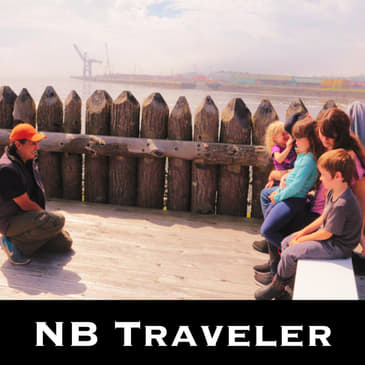
[00:04:47] and I walk them up through the city. I bring them out to the boardwalk. I show them a few places in the city that a lot of, even locals don't even know about, right? Partridge Island. We have Navy Island, which was, well, Goody Island at one time.
[00:05:02] We have the reversing falls. We have Fort LaTour. We, I show them all these places while trying to give them a little bit of history. I tell them, you always hear creation stories in the indigenous world. A creation story is this and creation story is that.
[00:05:17] So I sort of fashion a creation story of St. John. That's a little different than what the average person might hear where it involves the actual indigenous people and what they did to bring the people to this area kind of thing.
[00:05:30] But yeah, I check, I show them all those places, the Green Mound, which has the burial mound there and the old Fort LaTour archeological site. And if we're lucky, we get to see a seal or an eel or an osprey or something flying overhead kind of thing, right?
[00:05:48] So. Well, most of my listeners are not going to be on those cruise ships. Many of them will be right here in the St. John area. So what are some of the things that First Nations storytellers is doing that they might be interested in being involved in? Right.
[00:06:05] So for what we do, we do also that same tour but with the locals. Doing it with the locals is actually a little bit easier because they know a lot of the places and they know a lot of the history themselves.
[00:06:15] So I have the ability to tie in what I do with what they already know. We also do a kayaking tour up in Dominion Park Beach and that takes you along Dominion Park and Green Head Island. Last year we had partnered up with another company
[00:06:32] and they had already done tours and I was kind of like an add-on. And what I would do is I'd paddle off to the beach, start a fire, prepare some banek and some tea and reduce some storytelling on the beach kind of thing.
[00:06:44] So then I have a few other random things that I do as a company. I understand that in addition to that kayak tour there's also a 26 foot canoe that's up in Hampton and some place that are you still doing tours with that? We did.
[00:07:02] He's since sold that business. And we had contacted them about that canoe and he was willing to sell it and then we didn't know he was selling the company so he sold the company as is and the canoe went with it.
[00:07:17] So that fell through but I've still got my ear open for a similar one. That particular canoe was built in the Ormukta First Nations so I wanted to get my hands on that one. It's been perfect. It's been a perfect addition to what we do.
[00:07:31] So I understand that there's a powwow or something that may be coming up in the future. Any other activities in addition to that that you might want to talk about and then I want to specifically talk about the powwow. Well, there is always a little something happening here
[00:07:50] and there. The powwows are the big thing for the general public to go to. That's what they're meant for, for people to go and check it out. So the beginning of the powwow season has already started. I went to one up in Nova Scotia already,
[00:08:05] in the Guinness area. And so if they look online, they'll be able to find a listing of all those powwows and you can go to them all. You can check them all out. You could go for a day. You can go for two days.
[00:08:18] It's quite a lot to do if you want to get out there and learn the culture and see the culture. Now is there actually going to be one coming to the St. John area? Sure is. So my friend who works for the city started that
[00:08:31] and she's in the works, the funding has been put together and yeah they're going to have it at TD station as far as I know in October. Well we'll have another podcast closer to that when we can talk about some of the details
[00:08:47] and things with regard to it. I have always wanted to attend a sweat lodge ceremony. Is that something that a 1-16th chair key that's undocumented can get into? Or do I have to have more indigenous background in order to actually participate in a sweat lodge ceremony?
[00:09:11] Well I personally haven't been in a sweat lodge yet either. I've had a lot of invitations to go and I've turned them all down because I wanted to make sure that my first one was in my home community. I have seen online, if you know the right people,
[00:09:29] you're on the right groups, people advertising sweat lodges and stuff. I know UNB has one. Not sure how you get in there but I haven't been watching it because I'm trying to get my own but you kind of have to know people to know people kind of thing
[00:09:40] and getting out there and meeting some people and probably get you into it for sure. So where is your home community then? Well I'm from, it's commonly known as Red Bank. It's called Meta-Pinagyag, means high banks. It's up in the Merrimachie, past Merrimachie Newcastle.
[00:09:56] So thinking in terms of New Brunswick indigenous people, some of those issues that we continue to deal with for someone who's had a foot in both cultures. What kind of suggestions might you give with regard to how in the future
[00:10:22] New Brunswick can maybe be a little more open and helpful to dealing with some of those issues that we know are out there? Right, I talk about this. This is what I talk about on a daily basis. You've heard that story that I tell about the beaver? Yes.
[00:10:45] So that beaver and that story built a system on the land that was not good for the people themselves, right? Built this giant structure in the middle of the land that pretty much made the land unusable. That understanding is the understanding
[00:11:02] I want people in New Brunswick and Canada to understand that built atop of the lands that we called home for 14,000 years, they built this other society right on top of it. And that society wasn't necessarily built for our people. Our people live a certain way
[00:11:19] and even our people think a certain way that's different from the average person in Canada, right? So understanding that idea might help them realize that it's time to take that dam down or at least redesign it so it's not so negative to our people, right?
[00:11:36] Everything from healthcare to clean water to... There's a ton of things you can get into that are not or adversely affecting us. Myself included, I was taken out of my community at age one. That was part of that system that they were trying to propagate at the time.
[00:11:54] So if they understood that the system that they're living in is not designed for us, then they can understand that redesigning the system, even on a micro level, is a step towards reconciliation and figuring out that relationship better. Well, that is well said
[00:12:14] and I appreciate the opportunity to have that shared with my listeners because reconciliation is definitely something that we should be doing a lot more to work toward. Right. And I certainly appreciate the opportunity to talk with you and share with you today. Oh, thank you.
[00:12:38] And I really am looking forward to having you come back from time to time, share some more of your experiences and talk some about the pow wow particularly when it comes next October. Yeah, it's coming in October and it's going to be quite public, not by me.
[00:12:56] I'll be yelling it from my car, go to the pow wow as I'm driving by. Keep in mind you can go. There's no reason why you can't go. This one is not on a reserve yet, so it's safe. People are, you know,
[00:13:09] sometimes you have to see it going on the reserves. You know, they're not welcome. So going with this pow wow, you can definitely get an idea of what you're walking into and see it for the first time. Everyone knows TD station, you know, it's a really unfamiliar thing.
[00:13:22] Go in, sit down, enjoy dance during the intertribal dances if you want. Can't dance wrong. It's a dance. So just get out there and go buy some crafts or do, you know, just enjoy it. Well, thank you, Dave, for your time.
[00:13:37] And I hope that you have a good summer season with lots of opportunity to talk to not only those cruise passengers, but also a lot of the locals. Hopefully I'll see those locals out there. Thank you. Today, April 29th, 2024 is the first day of Uptown Burger Week.
[00:13:59] This is the 10th year that restaurants in St. John Uptown have been doing burgers that have specialties connected with them. And I like to think since we moved here just 11 years ago that they started all of this 10 years ago simply because I had come to town.
[00:14:20] I'm looking forward to eating some of those burgers this week and you can check out what's available by going to the show notes. I have a link there to Uptown Burger Week. It's been a real joy being with you today.
[00:14:40] I appreciate you taking the time to listen to the podcast. If you go to my website, mbtraveler.com, you can leave a comment, you can do a rating, and I look forward to seeing you back here again next week.
[00:14:54] And oh, by the way, you can also buy me a copy there on that website if you care to. Have a great day and a wonderful week.