
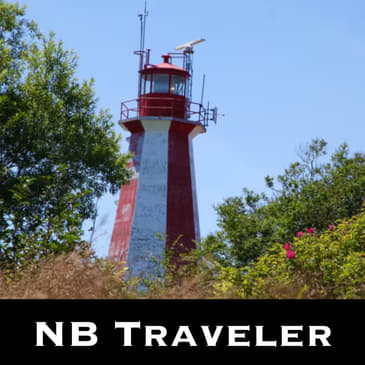

In this episode I discuss the rich history of Partridge Island, a site significant for navigation aids, quarantine stations, military fortifications, and lighthouses. I highlight the role of lighthouse keepers and their duties, including the use of foghorns and the invention of the steam-powered fog alarm. I also shed light on the island's quarantine station, its use as a burial ground, and its importance in controlling the spread of diseases during the 19th century.
Information for this podcast is Linda Hersey, Harold Wright and others that have contributed to seven different webpages which are listed below:
ihttps://www.saltscapes.com/roots-folks/3024-partridge-island.html
https://legionmagazine.com/the-sad-story-of-partridge-island/
https://www.atlasobscura.com/places/partridge-island-quarantine-site
https://newirelandnb.ca/quarantine-stations/partridge-island
https://www.pc.gc.ca/apps/dfhd/page_nhs_eng.aspx?id=191
https://maritimemac.com/2018/01/22/the-quest-of-saint-john/
https://mynewbrunswick.ca/partridge-island/
[00:00:03] I'm Mark, the Envy Traveler and here we talk about New Brunswick stuff. I've always been interested in things here in the St. John area and today we're going to be looking at one of the more prominent things that we have here in the area
[00:00:21] and that is Partridge Island. So sit back, get a cup of coffee and even go to my website and order one for me if you care to and here comes the program. Wait for it.
[00:00:38] I am a tour guide with Akila Tours and often do a highlights tour of the historic city of St. John. One of the first things that I point out as we leave the cruise terminal is an island that's sitting out at the mouth of the harbor.
[00:00:58] An island that was named Partridge Island because of the abundance of grouse that populated it at the time the French explorer Samuel de Champlain visited it in the early 1600s. Champlain's Akkadian descendants established a small base on the island's coastline
[00:01:19] and once the loyalists arrived in 1783 and founded the city of St. John it quickly became apparent that the island's strategic location made it perfect for navigation aids to secure passage into the harbor.
[00:01:35] This 24-acre island has played a significant role in the history of St. John and Canada itself. When I do the tour, I tell the cruise passengers that Partridge Island is to Canada much the same as what Alice Island is to the United States
[00:01:52] and while that is true, this quarantine station was established in 1785 almost 100 years earlier than the one on Alice Island. When St. John became the first incorporated city in Canada, the Charter set aside the island for three purposes a lighthouse, a military fortification and a pest house
[00:02:16] The marine station, the military post and the quarantine station in that order are the oldest uses of the island after the British arrived here as the loyalists in 1783. In the early 1780s, this enabling legislation was passed by the New Brunswick legislature to build a lighthouse
[00:02:40] it stipulated that levees on ships entering the harbor would pay to maintain the wooden structure The Partridge Island lighthouse built in 1791 was the first for New Brunswick and the third to have been built in Canada Located on the western tip, the lighthouse was banned by Captain Samuel Duffy
[00:03:01] and it lasted until the early 1830s when it was consumed by fire Just as important as the creation of light for navigation was the creation of sound Fog horns were manually operated and so when it got foggy, which happened a lot here in St. John
[00:03:21] the keeper himself would have to blow the horn Ship navigators were aided by the addition of a Minutek gun in 1801 and on September 8, 1831 a better solution was at hand when a thousand pound bell arrived aboard a ship from Liverpool, England
[00:03:42] This giant fog bell was placed atop a huge tower and operated mechanically but over time maintenance proved to be very, very expensive Meanwhile, something revolutionary was in the wings and Partridge Island would be the first in the world to put it into operation A steam powered fog alarm
[00:04:07] The inventor was Robert Folis, an engineer and artist from Glasgow, Scotland who moved to Canada in 1818 after his first wife died in childbirth In 1822, while settled in St. John, he was appointed deputy land surveyor
[00:04:26] and was responsible for surveying the upper St. John River to see if it would be suitable for steamship navigation He later patented a gas light device for use in lighthouses Folis developed the idea to build a revolutionary fog alarm using a steam whistle
[00:04:49] He toiled away for many years in the 1850s but could not interest the authorities in his work even after he submitted his plans to the Lighthouse commissioners Soon, he learned that a local engineer had built that device
[00:05:09] based on his plans and was taking credit for having designed it He eventually won recognition as the inventor and was credited for his work but even though the device was in wide use he never received a penny for its design Reportedly, he died in poverty in 1866
[00:05:35] Folis' invention was hailed as the marvel of its time and reportedly saved more ships and lives than any other navigational aid For almost 200 years, over two dozen lightkeepers and their assistants lived on the island When the Lighthouse was built in 1791, a military signal station was built beside it
[00:05:57] The keeper flew the yellow quarantine signal whenever disease was present aboard a ship The duties of the Lighthouse keepers were molded-fold and some of them served a role as well with the Partridge Island Quarantine and Immigration Station, the first in North America
[00:06:19] In the early 19th century, the already numerous ships began to increasingly carry human cargo Widespread famine in Europe was sending waves of individuals across the Atlantic in search of a better life and Canadian authorities responded in 1816 by converting Partridge Island into a pest house and a quarantine station
[00:06:44] Those immigrants fleeing the torment found themselves at Partridge Island and as a result of arriving there they had to follow the rules that had been established and those rules every person who had come into contact with anyone who was sick
[00:07:02] which basically meant everyone was to be inspected by doctors and then subjected to quarantine Kerosene showers were mandatory followed by hot water showers and steam cleaning of all clothing Those who didn't live through the quarantine process were interred in one of the island's six cemeteries
[00:07:28] The most numerous of all immigrant populations passing through Partridge Island were the Irish prompted by the potato famine of the 1840s So many Irish immigrants arrived in North America by way of this single speck of land that it earned the nickname Canada's Emerald Isle
[00:07:48] In the ten years between 1819 and 1829 the Partridge Island Quarantine Station processed nearly 30,000 individuals The 1800s saw the station's resources stretched to their limits as thousands of immigrants from Ireland many critically ill arrived From 1812 to 1850 about 71% of these immigrants were Irish
[00:08:16] The Irish immigration peaked during the 1845 to 1847 years due to the potato famine In 1844-2000 Irish immigrants arrived in New Brunswick That increased to 6,000 in 1845 and increased more to 9,000 in 1846 Most were impoverished and weakened by starvation making them susceptible to typhus and other deadly diseases
[00:08:47] Although there were hospitals on the island they were insufficient to accommodate all the sick In 1846, 13 shipmasters were prosecuted and convicted by St. John magistrates for overcrowding their ships maintaining poor conditions and providing inadequate provisions for passengers
[00:09:10] Immigrants were often confined to the dark well cargo holes of ships for weeks during the turbulent crossings essentially becoming human cargo Many of those who died en route were buried at sea by the captain's orders sometimes as a measure to avoid quarantine when they arrived at port
[00:09:32] The Irish referred to 1847 as Black 47 as it was the worst year The potato crop failed entirely leading tens of thousands to leave Ireland Many headed for British North America and Partridge Island received 15,000 of them during the summer of 1847 sending the already overwhelmed hospitals and facilities into complete disarray
[00:10:03] In June alone 35 vessels delivered 5,800 passengers to the island More than 2,000 people died that summer with approximately 800 dying during the dreadful low ages another 600 on the island and many more after they reached the mainland Those who died at the station were buried in Partridge Island's various faith-based graveyards
[00:10:28] Among those who perished that summer was a young St. John physician Dr. James Collins He was just 23 and newly married when he died only three weeks after arriving on the island to assist
[00:10:44] In 1854 a second wave of pestilence arrived at Partridge Island by way of boats arriving from Germany Collar raged on the island for two months and despite doctors best efforts spread to St. John where it cut through the town killing an estimated 1,500 people
[00:11:04] Between 1890 and 1914 the quarantine facilities were expanded to handle unprecedented numbers of immigrants primarily from Eastern Europe In total there were 13 hospitals on the island also a delousing plant for kerosene showers and residents for the staff
[00:11:26] Changing transportation methods and improvements in medical practices refocused the need for quarantine stations In 1938 the station was scaled down and formally closed in 1942 It's estimated that close to 3 million immigrants, passengers and mariners were subject to quarantine inspection on the island
[00:11:55] All in all the occurrences at Partridge Island never gained historic traction like those of other immigration checkpoints Instead existing primarily in stories handed down by mouths from family members who lived through it The island operated a small museum from 1982 until it shuttered 1995 once again making it
[00:12:21] And its history off limits to those who would wish to retrace their family steps Perhaps someday the story of Partridge Island can be properly told in some type of appropriate facility there on the island itself But for now it's off limits
[00:12:39] The third role of the island was as a military installation perhaps the subject of a future podcast Information for this podcast came from the writings of Harold Wright, Linda Hershey and others The websites that I gained information from are all linked in the show notes
[00:13:20] I'm Harold Wright and I look forward to seeing you back here again next week And oh by the way you can also buy me a copy there on that website if you care to Have a great day and a wonderful week