
This episode deals with the history of leprosy in New Brunswick and the government’s policy of forcing the “lepers” as young as eight to segregate on Sheldrake Island without adequate accommodation or support. Basically, deals with the types of decisions that communities and governments make when pressured by fear, ignorance, or hidden agendas. The episode also highlights the efforts of the Acadian community to not allow the names of the 15 individuals that died on the island to be forgotten.
Video and Lesson plans - https://loststories.ca/sheldrake/
https://www.canadashistory.ca/explore/arts-culture-society/the-lepers-of-tracadie
https://leprosyhistory.org/geographical_region/site/canada
https://en.wikipedia.org/wiki/Leprosy_Act_1906
[00:00:00] I am Mark, the New Brunswick Traveler and here we talk about New Brunswick stuff.
[00:00:11] There's so many great wonderful treasures and natural resources here that we can experience
[00:00:17] from the Bay of Fundy to Mount Carlton to all of the various things that are in between.
[00:00:24] So for now, let's get started.
[00:00:29] Last week I read one of the murder mystery stories from Steve Vernon's book Maritime
[00:00:35] Murder, Deadly Crimes from the Buried Past.
[00:00:40] As I was looking through some of the other New Brunswick stories in the book, I came
[00:00:44] across one that was about a man that began to show symptoms of leprosy in the 1860s.
[00:00:51] While I was familiar with the cholera and typhoid epidemics that plagued the province
[00:00:57] in the 19th century, the information about leprosy was somewhat of a surprise.
[00:01:03] I think of it as a far off disease in India, certainly not a Canadian problem.
[00:01:10] So I decided to take a deeper look at the history of the disease in New Brunswick
[00:01:15] and what I learned was that the very first case of leprosy in Canada was found
[00:01:22] right here in New Brunswick.
[00:01:25] The actual source of leprosy in New Brunswick remains a mystery.
[00:01:30] Some historians believe that the organism may have been carried by Acadian exiles returning
[00:01:36] from Louisiana.
[00:01:38] Alternately it may have originated in Norway.
[00:01:43] Canada's first documented case of leprosy was in 1815 when Ursula and Joseph Benedict
[00:01:50] contracted the disease and later died after two Norwegian sailors covered in sores spent
[00:01:58] the winter in their home.
[00:02:01] There was an Acadian woman living in eastern New Brunswick that showed symptoms of leprosy
[00:02:06] in 1817, dying of the illness in 1828.
[00:02:12] By 1842 only 40 cases had ever been identified and this was in a population area of 10
[00:02:21] or 22,000 people.
[00:02:23] Not significant enough to cause alarm or panic.
[00:02:28] But communities and governments sometimes make bad decisions anyway when faced with
[00:02:37] enough pressure created by unwarranted fear.
[00:02:42] This is what happened in 1844 after a provincial medical commission decreed that all weapons
[00:02:50] suppers, some as young as eight, be rounded up and forced to live at the old cholera
[00:02:58] quarantine station on Sheldrek Island which was located at the mouth of the Miramichi
[00:03:06] River approximately 80 kilometers from the homes of these individuals that were forced
[00:03:14] to go there.
[00:03:16] Unfortunately for those Acadians the New Brunswick government was under intense pressure
[00:03:23] to confine the leopards and they were left to decay in their medieval style sheds on
[00:03:30] the 32 acre island.
[00:03:33] General apprehension drowned the more moderate medical voices.
[00:03:40] After the quarantine was abandoned the leopards were to live out the remainders of their
[00:03:44] lives there on the island.
[00:03:46] The quarantine sheds that they were to live in were airless, dark, cold and dirty.
[00:03:54] Medical care was nonexistent.
[00:03:56] Doctors refused to go to the island to check on them.
[00:04:00] The less crippled were expected to care for the more mutilated.
[00:04:05] They even had to ding their own well to have water.
[00:04:09] Up to 44 different individuals were banished there with little food or shelter and of
[00:04:15] that number 15 died and are buried right there on the island.
[00:04:24] To make sure that they didn't leave the island there were guards that were stationed
[00:04:28] there.
[00:04:29] From time to time some of the patients would escape but were always caught and
[00:04:36] brought back to the island.
[00:04:39] In 1849 a Canadian physician Dr. Robert Bayard wrote that the
[00:04:46] crime-less sufferer has been condemned by the legislator of his country to perpetual
[00:04:57] imprisonment.
[00:04:59] Dr. Bayard maintained that the disease was not transmissible.
[00:05:07] Dr. Bayard said that the medicine doesn't agree with that position totally but only
[00:05:12] about 1% of those exposed will ever develop full-blown leprosy.
[00:05:18] A leper colony mandated by the New Brunswick government was an overreaction to a health
[00:05:25] issue that could be easily controlled without segregation.
[00:05:32] There was significant outrage over the situation of those on the island fueled by
[00:05:37] Acadian resentment that conjured up memories of their 18th century deportation.
[00:05:45] This resentment led to the relocation of the patients in 1949 to a new
[00:05:52] facility near their families in Trikati.
[00:05:58] Only 14 were remained alive at that time.
[00:06:04] The real improvement though occurred in 1868 when seven Montreal sisters of St. Joseph
[00:06:11] arrived in the colony to help.
[00:06:15] The last Acadian patient admitted to the leprosarian was in 1937 and the
[00:06:23] facility closed in 1965.
[00:06:26] In total, 367 leprosy patients were treated there over its existence.
[00:06:35] Today the disease is referred to as Hansen's disease after Armar Hansen, a Norwegian
[00:06:44] who discovered the causative bacteria in 1873.
[00:06:50] It is quite rare but does still occur in Canada from time to time.
[00:06:56] Most individuals have natural immunity to it and only 5% of the population are truly
[00:07:03] vulnerable to it.
[00:07:06] Perhaps 15 individuals dying on Sheldrake Island abandoned and alone seems like a
[00:07:13] small insignificant number and for a time their names were even forgotten.
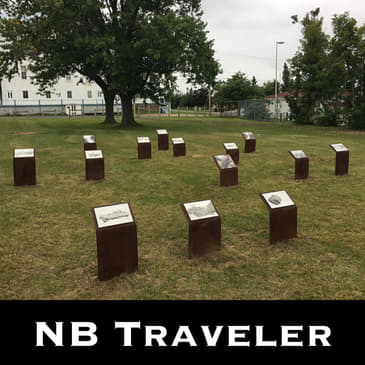
[00:07:20] Through the efforts of the Sheldrake Commemorative Committee, the names were
[00:07:25] discovered and a fitting memorial to the 15 was installed in Trikati in
[00:07:32] September 2017.
[00:07:36] A beautiful documentary of the journey of discovery gives honor to the 15 and
[00:07:42] more history of their experience on the island.
[00:07:46] A link to the video is in the show notes.
[00:07:49] I hope that you will take the time to watch it.
[00:07:53] The project that produced the documentary also developed a set of lesson plans and
[00:07:59] historical documents that encourage critical thinking about the history that
[00:08:04] is literally all around us.
[00:08:08] Teachers and students consider why some stories from the Canadian past have
[00:08:14] been commemorated through historical markers such as monuments while other
[00:08:19] stories have been ignored.
[00:08:23] Those lesson plans can also be found at the link in the show notes.
[00:08:30] Trikati is a vibrant Acadian community located along Highway 11 in
[00:08:37] northeastern New Brunswick, about halfway between Miramichi and the
[00:08:42] Acadian Peninsula.
[00:08:45] It is known for its warm hospitality and seaside location making it a
[00:08:52] popular tourist destination.
[00:08:55] When you visit there please make sure that you visit the area where the
[00:09:00] monuments are to the 15 Sheldrake deceased.
[00:09:06] In closing, I just want to emphasize again that communities and governments
[00:09:11] sometimes make unwise decisions from the pressures of fear, ignorance,
[00:09:19] or hidden agendas.
[00:09:22] Unfortunately those that are affected often do not have voices that can
[00:09:29] speak back sufficiently.
[00:09:33] It's up to the rest of us to be the voice for those that communities and
[00:09:38] governments have placed away to be forgotten if possible.
[00:09:50] It's been a real joy being with you today.
[00:09:52] I appreciate you taking the time to listen to the podcast.
[00:09:56] If you go to my website, MBTraveler.com, you can leave a comment.
[00:10:02] You can come to do a rating.
[00:10:04] I look forward to seeing you back here again next week.
[00:10:08] Oh, by the way, you can also buy me a coffee there on that website if you
[00:10:13] care to.
[00:10:15] Have a great day and a wonderful week.