
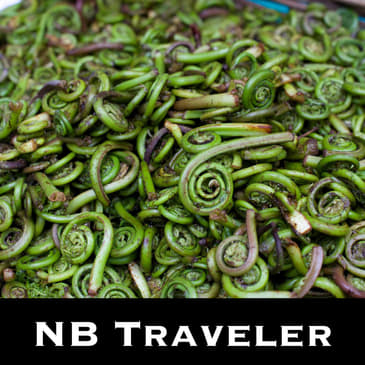

This episode talks about fiddleheads and their popularity in New Brunswick. The village of Tide Head New Brunswick bills itself as the Fiddlehead Capital of the World. Perhaps it is, but Saint John has the only Fiddlehead sculpture. It was made by Jim Boyd of Sussex and sits in front of the Arts Centre.
The predominant type of fiddlehead in Canada is the ostrich fern (Matteuccia struthiopteris). These are bright green, with tightly coiled heads, sometimes with bits of the forest floor still clinging to them. With a flavor slightly reminiscent of asparagus, but somehow also nutty and pleasantly bitter, they are a short-lived but delicious reminder that the doldrums of winter are finally over.
I refer to an article by Raymond Plourde entitled “Fiddlehead Season” in Saltscapes Magazine for some of the information found on the podcast.
https://www.saltscapes.com/kitchen-party/1068-fiddlehead-season.html
To learn more about harvesting opera fiddleheads, this video might be helpful: https://www.youtube.com/watch?v=rBfG6yyPtAg
Information about freezing or pickling fiddleheads
[00:00:04] I am Mark, the MB Traveler and here we talk about New Brunswick Stuff. A special thanks to Christine who bought me a cup of coffee by going to my website there at nbtraveler.com. Today we're going to talk specifically about
[00:00:22] Fiddleheads so let's get started. Have you ever eaten a fiddlehead or even ever heard of one? We have just finished the short fiddlehead season here in New Brunswick and because I had been traveling in Italy and Kentucky I missed
[00:00:48] having any fiddlehead soup this year. The predominant type of fiddlehead in Canada is the Austeridge Spurn. These are bright green with tightly coiled heads sometimes with bits of the forest floor still clinging to them with a flavor slightly reminiscent of asparagus but somehow also nutty and
[00:01:11] pleasantly bitter. They are short-lived but delicious reminders that the doldrums of winter are finally over. In an article titled Fiddlehead Season in The Salt Scapes Magazine Raymond Pleder states this unassuming little fern may be the world's next superfood. He goes on to write, people go in early
[00:01:39] spring and small groups are alone as they have done for centuries. Some in canoes and some on foot kitted out with small knives buckets bags and baskets. A small army of maritimeers spreads out combing riverbanks and forest floor seeking the much loved little woodland fern known as the
[00:02:05] fiddlehead. Reading a little more from the article on fiddlehead season in the late 1700s when United Empire loyalists first settled in the St. John River Valley they were ill-prepared for life in the Acadian Forest and especially for the harsh winters. The maliceat taught the bedraggled newcomers
[00:02:30] many valuable lessons in survival including how to find, pick and prepare fiddleheads in the springtime. For natives and newcomers alike fiddleheads were not only fresh food at a time of scarcity they were also a much needed
[00:02:49] shot of vitamins and micronutrients. I'll put a link in the play notes to the whole article. Some key characteristics of fiddleheads they have a bright green color and a tightly coiled shape resembling the scroll of a violin hence the name fiddlehead. They're typically harvested in early spring
[00:03:12] making them one of the first foraged vegetables of the season. Fiddleheads have that unique flavor often described as similar to asparagus with nutty notes. Austeridge fern fiddleheads are probably the most popular in Canada and the United States. They can be identified by their bright green color brown paper
[00:03:42] recoverings on the coils and a deep u-shaped groove on the inside of the stem much like that groove that you would find on a stalk of celery. It's crucial to properly identify fiddleheads as some species are toxic. Foragers should leave
[00:04:03] some fiddleheads on each plant to ensure sustainability. A typical fiddlehead plant will have seven of these ferns emitting from it and foragers if they want to sustain that plant would only take three. Fiddleheads are versatile in the
[00:04:23] kitchen can be used in various dishes like sautees, soups, pasta and as side dishes. They're popular not just in North America but in many cuisines worldwide and crilleting Korean, Japanese and Indonesian cooking. As I mentioned fiddleheads have a short season typically from late March through June with the
[00:04:50] season starting first in British Columbia and then ending finally in New Brunswick. They're often found at farmers markets and specialty stores rather than regular supermarkets. Fresh fiddleheads should be stored in a refrigerator and they'll last for at least a week that way. Frozen fiddleheads
[00:05:11] can be used for up to a year. It is essential to thoroughly clean and cook fiddleheads before eating. Raw or undercooked fiddleheads can cause food borne illness. Recommended cooking methods include boiling for 10 to 15 minutes or steaming at least 10 minutes before further preparation. They do
[00:05:36] offer many health benefits. Fiddleheads are low in calories but high in essential vitamins and minerals including vitamin A, vitamin C, potassium, magnesium, copper and iron. They contain antioxidants and anti-inflammatory compounds that may help protect against oxidative stress and reduce the risk of chronic
[00:06:00] diseases like cancer and heart disease. Fiddleheads provide plant-based omega-3s which are beneficial for hard health, brain function and reducing inflammation. They're a good source of dietary fiber which aids in digestion promotes feelings of fullness and may help with weight management. Fiddleheads
[00:06:26] contain niacin, vitamin B3, which may help boost good cholesterol levels and lower bad cholesterol levels. The high potassium that they contain may help maintain healthy blood pressure levels. The vitamin C content in fiddleheads helps strengthen the immune system. Fiddleheads are rich in vitamin A which is important
[00:06:51] for maintaining good vision and preventing macular degeneration. The copper and iron content in fiddleheads is essential for the formation of new red blood cells. It's important to note that fiddleheads must be thoroughly cooked before consumption to avoid potential foodborne illness. When
[00:07:14] prepared properly they can be a nutritious and unique addition to a healthy diet or as the author I cited above has stated in the article Fiddlehead Season, the unassuming little fiddlehead is a heavy weight in the health food department and they well become the world's next
[00:07:40] superfood. I was surprised to find that in addition to finding fiddleheads in the wild they're also being grown commercially at a couple of places in Ontario. Norcliffe farms is the largest distributor of wild fiddleheads through their brand forage girl fiddleheads. I will provide a link to their website
[00:08:05] in the play notes since there's information there about freezing or pickling fiddleheads. I've also put a link in the show notes to a video that will give you additional tips on picking one of the opera fiddleheads so that you do it properly. Unless you can find some
[00:08:26] preserved fiddleheads or frozen fiddleheads you will have to wait until next spring to experience them. Hopefully you will have the opportunity to try them. The village of Tidehead, New Brunswick builds itself as the fiddlehead capital of the world perhaps it is
[00:08:45] but St. John has the only fiddlehead sculpture that I know of. It was made by Jim Boyd of Sussex and sits in front of the art center here. To stay up with what's happening in Atlantic Canada keep listening to this podcast. In addition you might want to
[00:09:03] subscribe to the SaltScape magazine. It's published seven times a year and with a two-year subscription I pay about five dollars a magazine which is half of the newsstand price. I hope that this information about fiddleheads and the uniqueness that they have will be helpful to you
[00:09:27] and that next spring you'll have the opportunity to try them. I spent a real joy being with you today. I appreciate you taking the time to listen to the podcast. If you go to my website mbtraveler.com you can leave a comment, you come to do a rating
[00:09:50] and I look forward to seeing you back here again next week. And oh by the way you can also buy me a copy there on that website if you care too. Have a great day and a wonderful