
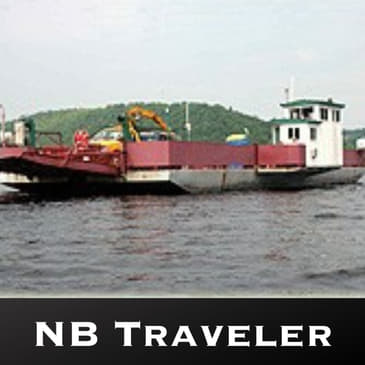

The cable ferry was invented in New Brunswick. We have eight of them on the St. John river system. They all operate as part of the highway system at no cost to drivers.
Just north of Saint John is the Kennebecasis Peninsula, an area settled very early after the Loyalists arrived in 1783. As early as 1825 there was a type of ferry service crossing the Kennebecasis River from Reeds Point to Gondola Point. These early ferries were really nothing more than a rowboat, later enlarged and fitted with a sail so that they could take one horse and buggy across the river. Their existence was vital to the farming community that existed on the peninsula.
William Pitt began operating one of these small sail and oars scow by the 1870s. In 1903, he invented the cable ferry. Unfortunately, he died in 1909 when he fell into the equipment. But his invention became something that is used worldwide.
There is a website www.discoverthepassage.com that highlights traveling the ferries of the lower river passage along the St. John River. Cable ferries quickly spread throughout the region in the early 1900s, though they were sometimes replaced in winter by ice roads. These ferries are specially engineered to cope with New Brunswick’s winter and early spring runs of river ice.
Ice can be particularly worrisome for the ferry captain. The extra strain on a cable may cause it to break. In that case, the ferry would drop anchor and wait for another ferry, or a tugboat to rescue it.
There have been times that the government of the day has tried to eliminate some of the cable ferries, citing the cost of maintenance and operation. That occurred in 2016 when the Gagetown Ferry was removed from service. That ferry had been in service for 90 years and without the ferry it was a 70 km round trip to get to services that were located just five minutes away by boat. It took four years of yard sign and social media protest, and a change of government, but the service was restored – at least in the summer. When the river freezes over then the residents can use an “ice road” to go from one side to the other. The same thing is done by the few residents on Kennebecasis Island when the seasonal ferry ceases operation, usually in November. That passage is the shortest of any of the cable ferries at 500 metres.
For the residents, cable ferry service is a highway link for them to cross the river when bridges would be unfeasible. They know that if the ferry is down, you are going to drive around. For instance, if the two Gondola Point Ferries are out of service it is a 38 km drive to get from the one ferry dock to the one across the river only ½ mile away.
The cable ferries in New Brunswick all travel less than 2/3 mile from one side of the river to the other. Typically the trip is 5 to 7 minutes. But it is possible for cable ferries to travel a greater distance than that. The longest cable ferry in the world is located in British Columbia on Baynes Sound and goes from Vancouver Island to Denman Island, a distance of 1 ¼ miles. The diesel powered Peninsula Princess that ravels on the Kennebecasis River from Milledgeville to Summerville covers a similar distance on a trip of 15 minutes. Had the province chosen to make that as a cable ferry, New Brunswick might have had the world record for the longest one.
So cable ferries are a very important part of the lifestyle of those of us in southern New Brunswick. In the words of local song writer Brent Mason: "Take your car, take your bike, take your half-ton truck/ It's the last thing left that don't cost a buck/ The very best things in life are free/ So take a ride, ride, ride on the Evandale Ferry."
[00:00:00] I am Mark the New Brunswick traveler and here we talk about New Brunswick stuff.
[00:00:13] On this podcast I'll be talking about some of those natural wonders, be talking about
[00:00:18] some of the people that live in New Brunswick, past visitors that have come to New Brunswick
[00:00:23] and maybe even some ghosts that, particularly in the St. John area. Last week I mentioned that New Brunswick might have been where the telephone was invented. This week I. By the 1870s, in 1903 he invented the cable ferry, which was a much larger vessel designed to take two horses and buggies at a time or maybe more. To lay the cable, he stretched it out on the ice, and then when the ice melted in the spring, the. On one hand, they function as small stable drive-on and off platforms, convenient floating links in a highway system in which bridges would be unfeasible. On the other hand, they offer the excitement of any water-borne trip,
[00:04:20] a series of unique perspectives upriver and down, and the thrill of a gradual approach making for risky crossings at the start and close of the season. These ferries are spatially engineered to cope with New Brunswick's winter and early spring runs on ice, followed by the annual flood or fresh net. Ice in the meld off on the river in the spring can be
[00:05:40] particularly worrisome for the ferry captain. The eliminate some of the cable ferries citing the cost of maintenance and operation. That occurred in 2016 when the Gagetown ferry was removed from service. That ferry had been in service for 90 years and without the ferry it was a 70 kilometer round trip to get the services that were located just five minutes away by boat across the
[00:07:06] river. service. It's a 38-kilometer drive to get from one ferry dock to the one across the river, which is only a half a mile away. Growing up in Indiana, I did not have much opportunity experience riding on a ferry, but I do remember a family trip that we took to and was built and put into service in 2016. It's also the largest cable ferry in the world with the capacity of 150 at the Imperial Theatre. This 102-member orchestra is absolutely fantastic. And their next performance will be February the 11th in Fredererton. For more information