
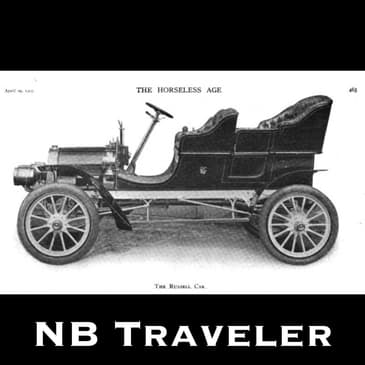

The province of New Brunswick has some great 4-lane highways and good by-roads, but this was not always the case. The preoccupation with railway construction took much of the government’s focus in the early part of the 20th century. It was only with a strong push from the Boards of Trade of Saint John and Fredericton that road construction finally began sufficiently in 1917 and beyond. By the early 1920’s the tourism industry in the province was growing significantly because of the popularity of the automobile and the good roads that the province was building.
The Impact of the Automobile on the Government of New Brunswick written by Charles Joseph Allain
Was the First Car Invented in Canada written by Andrew McClean
Early Motoring in New Brunswick written by Ruby Cusack
[00:00:00] I am Mark the New Brunswick Traveler, and here we talk about New Brunswick stuff.
[00:00:13] New Brunswick's often referred to as a drive-through province going to Prince Edward
[00:00:18] Island or Nova Scotia but more and more were becoming a destination province where
[00:00:24] people are coming to spend the night, spend a week, or spend the rest of their life.
[00:00:32] There's so many great wonderful treasures and natural resources here that we can experience
[00:00:38] from the Bay of Funday to Mount Carlton to all of the various things that are in between.
[00:00:45] On this podcast I'll be talking about some of those natural wonders.
[00:00:50] We're talking about some of the people that live in New Brunswick past visitors that
[00:00:54] have come to New Brunswick and maybe even some ghosts that I find along the way.
[00:01:00] So for now, let's get started.
[00:01:04] I recently made a trip from St. Stephen at the main border to St. John where I live in
[00:01:16] a little over one hour on a beautiful four-lane highway.
[00:01:20] It's a distance of about 72 miles.
[00:01:23] On the drive I was thinking about what it would have been like 100 years ago to have made
[00:01:27] the same journey from St. Stephen to St. John.
[00:01:31] I even pretended that I would have been fortunate enough to have borrowed Mrs. Harry Southerner's
[00:01:37] red piracero automobile.
[00:01:40] Her last name was spelled SOUTHAN and the information that I have and she had a New Brunswick license
[00:01:50] registration number that was 1,404.
[00:01:55] This six cylinder car was built in Buffalo, New York and President Howard Taft had two of
[00:02:00] them purchased to be used as the official cars of the White House.
[00:02:05] Not better way to be traveling than to be in that kind of luxury.
[00:02:10] Eight years before that piracero was registered, the first automobile officially registered
[00:02:16] in New Brunswick was a Rambler with serial number 5762 belonging to J. Walder, Holly of
[00:02:24] St. John.
[00:02:26] There's no indication that this was a one or two cylinder engine.
[00:02:30] It was manufactured in Kenosha, Wisconsin and sold for $750 which would be $35,869 Canadian
[00:02:40] dollars today.
[00:02:43] There were 12 cars registered in the province in 1905.
[00:02:48] The Russell Motor Company car was the first thoroughly Canadian car and was targeted at
[00:02:55] the high end market with sales offices in England, Australia and New Zealand.
[00:03:02] The cars were manufactured in Toronto and they're considered to have produced the first
[00:03:07] successful Canadian automobile.
[00:03:10] The first Russell car registered in New Brunswick had license number 20 and was registered
[00:03:17] on May 25th, 1906 to Bernard Miller in St. John.
[00:03:24] That year 41 cars were registered until 1911, the province only issued numbers and the
[00:03:31] car owners made their own license plates.
[00:03:35] Those license plates often were handmade on a piece of wood with number written on it
[00:03:42] in ink or paint but some of the license plates were actually made at a local company that
[00:03:50] produced porcelain license plates.
[00:03:53] There is the possibility of the automobile was actually invented in New Brunswick by Thomas
[00:03:58] Turnbull in 1851.
[00:04:01] Andrew McLean and his backyard history goes into detail about the three wheeled buggy
[00:04:06] that was observed driving on the streets of St. John by upwards of a thousand people.
[00:04:13] Mr. Turnbull would not reveal the power source that was covered by a tarpoliun saying that
[00:04:19] he was going to file a patent for it.
[00:04:22] According to the McLean podcast, that summer there was an outbreak of cholera in St. John
[00:04:28] killing 1500 at the city's 30,000 residents listed among the dead was a carpenter, Thomas
[00:04:37] Turnbull.
[00:04:38] Now back to my fantasy trip of traveling 100 years ago in that Pierce Arrow.
[00:04:47] Going at that time I would have been traveling on one of New Brunswick's five great roads,
[00:04:53] a road that was in much better shape in 1924 than it was in 1913 when Mrs. Southern
[00:05:01] registered that car.
[00:05:04] Particularly the section of it on further east of St. Andrews towards St. John.
[00:05:11] On August 1909 the New Brunswick got a mobile association that singled this highway out as
[00:05:18] one of the great concerns and that its condition had adverse effect on St. John's tourist
[00:05:24] trade.
[00:05:25] According to the association, the condition of the road was stopping an estimated 20 American
[00:05:33] cars from crossing the border daily during the summer months.
[00:05:38] Then as late as 1912 tourists still had to detour some 10 miles to avoid some 5 miles
[00:05:46] of desolate and impassable country road over the old post road between St. John and La
[00:05:54] Pro.
[00:05:56] I'm sure that living in St. Andrews in 1913 the residents would have been aware that
[00:06:02] the association had persuaded the villages of St. John and La Pro to join together and
[00:06:09] do what the province seemed to be incapable of doing, repairing that five miles of undriveable
[00:06:16] road so that their tourists could easily get to St. John.
[00:06:22] Mrs. Southern probably only spent summers in St. Andrews, and she wasn't there on
[00:06:27] that Saturday afternoon on April 16, 1914 when the Algonquin Hotel burned to the ground.
[00:06:35] The water supply had been turned off for the winter so there was little to fight the
[00:06:40] fire with according to the report that I saw, the summer home of Mr. Southam, SOUTHAM,
[00:06:49] of Ottawa was spared along with four others that were beside it.
[00:06:54] I wonder if Mrs. Harry Sutham, SOUTHAM actually was married to Mr. Southam and lived in
[00:07:09] that beautiful summer home and actually was from Ottawa.
[00:07:14] At any rate that fire was in 1914 and now I'm pretending that I'm driving in 1924
[00:07:22] in that beautiful red pierce arrow on this great road.
[00:07:27] The roads gravel and of the construction and quality that it became in 1919 the standard
[00:07:34] for the federal road construction in other provinces.
[00:07:38] It is a longer route than the one that currently exists between St. Stephen and St. John because
[00:07:47] it went through St. Andrews when the route was 88 miles long, 16 miles further than the
[00:07:54] modern four lane one.
[00:07:57] I had to watch the speed in that pierce arrow in 1924 a driver could be put in prison if
[00:08:04] he exceeded 40 miles an hour.
[00:08:08] This is of being caught though or slim since the New Brunswick Provincial Police Force
[00:08:13] was not established until three years later in 1927.
[00:08:19] These new great roads were ideal places for the run runners to go zooming through as
[00:08:25] they took the liquor to the US border.
[00:08:28] The force was established not only to curtail the bootlegers but also to control the
[00:08:33] Yankee speeders that had come across the border and to provide some support to local
[00:08:39] community constables.
[00:08:41] If a run runner was stopped the liquor in cash would be confiscated and the car would
[00:08:47] become one of the police force's new vehicles.
[00:08:52] In 1935 the province disbanded the force and contracted with the RCMP for future law
[00:09:00] enforcement.
[00:09:01] To assure that the great route I was traveling on in 1924 was in good repair patrol crews
[00:09:11] consisting of two men and a horse drawn greater were employed with one team assigned to
[00:09:18] a section of six to ten miles depending on the amount of traffic that was there and
[00:09:23] the terrain.
[00:09:25] In 1923 3357 American cars came in to St. Stephen representing 35 different states with almost
[00:09:34] half of them being from Massachusetts.
[00:09:37] There were two cars from Bimuda and one from Hawaii.
[00:09:41] The quality of the great road in 1924 came as a result of a lot of political pressure
[00:09:47] that was exerted by the boards of trade in St. John and in Fredritan.
[00:09:54] The desire of this quality of road and the impact that it would make on tourism came
[00:10:01] to be best represented by an editorial in the busy east a few years earlier entitled
[00:10:08] We Want Good Roads for the Maritime Provinces.
[00:10:13] The editorial reads,
[00:10:15] We are the possessors of a historical past famed in song and story and we are situated
[00:10:22] with a large tourist traffic at our very doors only awaiting the opportunity for entry.
[00:10:29] Our country by the Atlantic will never become fully known as it should be known and it
[00:10:35] will never derive from the sightseer and the tourist the revenue for which its historical
[00:10:42] associations and its matchless scenery entitle it until
[00:10:49] the horn of the motorist is heard resounding from every by road and highway.
[00:10:57] To the south of us are a people imbued with the wonderlust of their pilgrim forefathers
[00:11:04] with money to indulge themselves to the limit given the proper road facilities and the thousands
[00:11:14] of cars which approach the main border every summer only to be turned back by the
[00:11:20] ruts and bumps line beyond will they continue their journey to bring money to our pockets
[00:11:29] and new life to our doors.
[00:11:33] The automobile and not the passenger train became the driving force behind tourism
[00:11:39] in the province. For a period of time the government had been obsessed with building
[00:11:44] the valley line, the St. John and Quebec railroad construction that started in 1912.
[00:11:54] The route did not make a lot of sense since it covered some of the same areas the well
[00:11:58] established Canadian Pacific Railway but the province knew they would get 40% of the
[00:12:04] profits if the line was completed and successful. It was taking the province attention and finances
[00:12:12] away that could have been used in the Great Roads program. The route was finally completed
[00:12:18] in 1919 and went into operation. It didn't take very long for the government to realize
[00:12:24] it had a red herring on its hands and ultimately sold it to the CPR in 1929.
[00:12:34] One of the driving forces behind the Better Roads movement in New Brunswick was the
[00:12:39] automobile owners. At first the rural community was very resistant to the presence of automobiles
[00:12:46] on the rural roads. Prince Edward Island even banned cars for a period of time. In fact
[00:12:53] there were attempts in New Brunswick which were to have cars banned on rural roads three
[00:13:00] days a week but it never became legislation. The farmers for many years were content with
[00:13:06] their horses and buggies and with their ox carts. But then all that began to change. Between
[00:13:13] 1917 and 1930 motor vehicle registration in New Brunswick jumped from 4,880 cars almost
[00:13:22] 28,000 cars. 1917 only 6% of the cars registered were owned in rural districts. 1921 it was
[00:13:32] 40% and by 1923 58% of the registered vehicles were in rural districts. So now the political
[00:13:45] pressure was on bringing the buy roads up to the same standard that existed on the Great
[00:13:50] Roads. That is still a work in progress that I can attest to from some of the muddy roads
[00:13:57] that I've driven on this spring, going directly from point A to point B instead of sticking
[00:14:05] to one of our great highways. There were many reasons why New Brunswick was able to embark
[00:14:11] on a road improving the boom during the 1920s to 1930 but some of the main ones were the
[00:14:18] use of the automobile license and registration fees specifically for road building. The
[00:14:24] Dominion of Canada contributed money through Canada Highway Act of 1919 which provided five
[00:14:31] years of shared investment with the province in the building of New Roads. New Brunswick was
[00:14:38] the first province eligible for taking advance of this money. A year ahead of any other
[00:14:46] province. The introduction of the gas tax in 1926 gave the government the money needed
[00:14:53] to do the improvement to the roads in the province. It's up to the citizens to put pressure on where
[00:15:01] the road building and maintenance takes place. We have some of the best highways in Canada
[00:15:08] with very little traffic to get in your way as you explore the many wonderful things that
[00:15:16] the province has to offer.
[00:15:19] Now it's been a real joy being with you today. I appreciate you taking the time to listen
[00:15:29] to the podcast. If you go to my website mbtraveler.com, you can leave a comment, you come to do a
[00:15:36] rating and I look forward to seeing you back here again next week and oh by the way, you
[00:15:42] can also buy me a coffee. They're on that website if you care to have a great day and a wonderful
[00:15:50] week.